Table 4 · Developed project · Thursday
AI-readable standards snippets
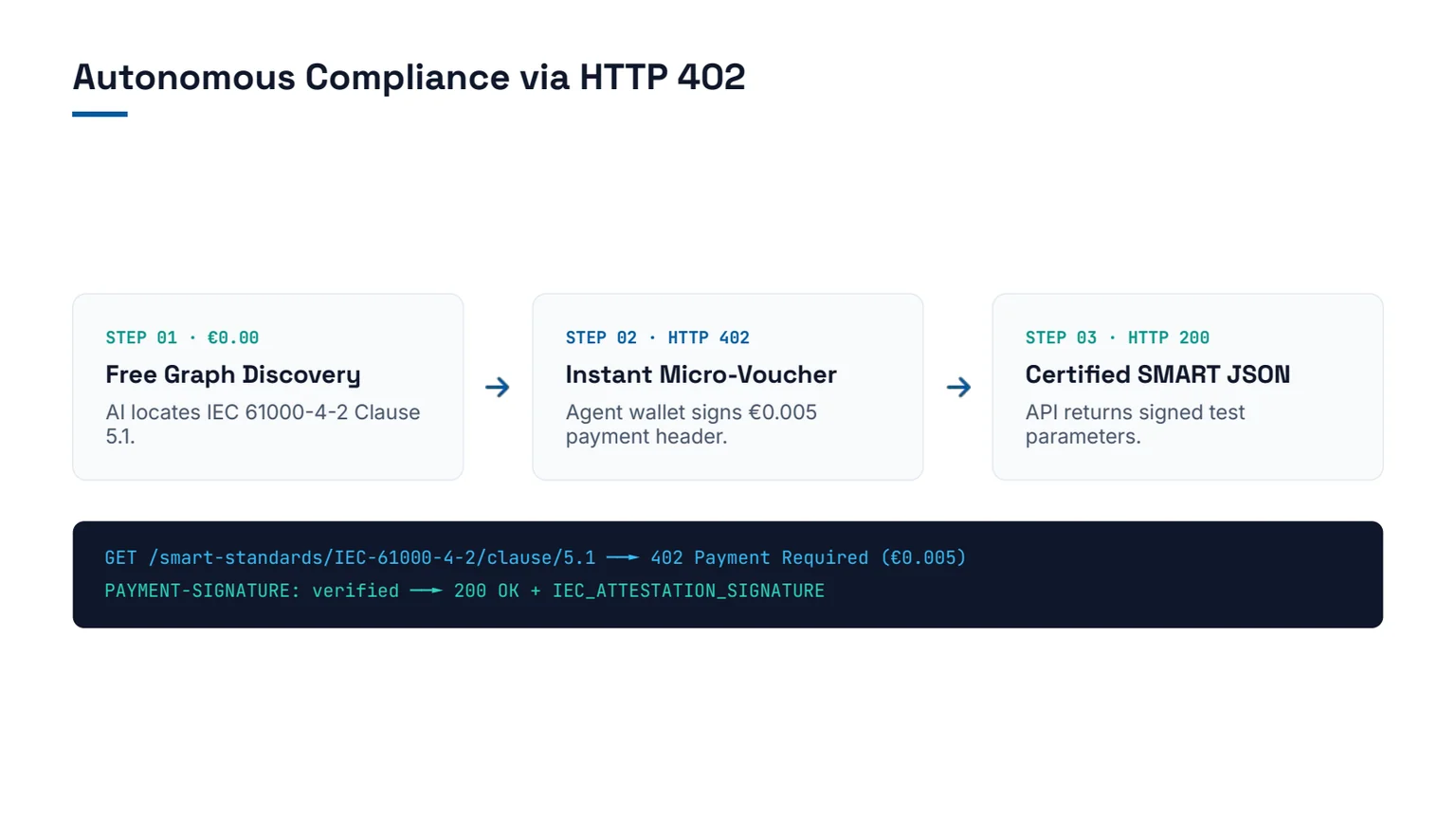
An engineering tool might need a particular test parameter or requirement. The team proposed letting the software license that part of a standard on demand. Its model distinguishes requirements, recommendations and the context that lets an engineer interpret them.
What the team learned
The group developed the clause-licensing route into a pay-per-use proposal for software.
Wednesday · 18 November
Three early concepts
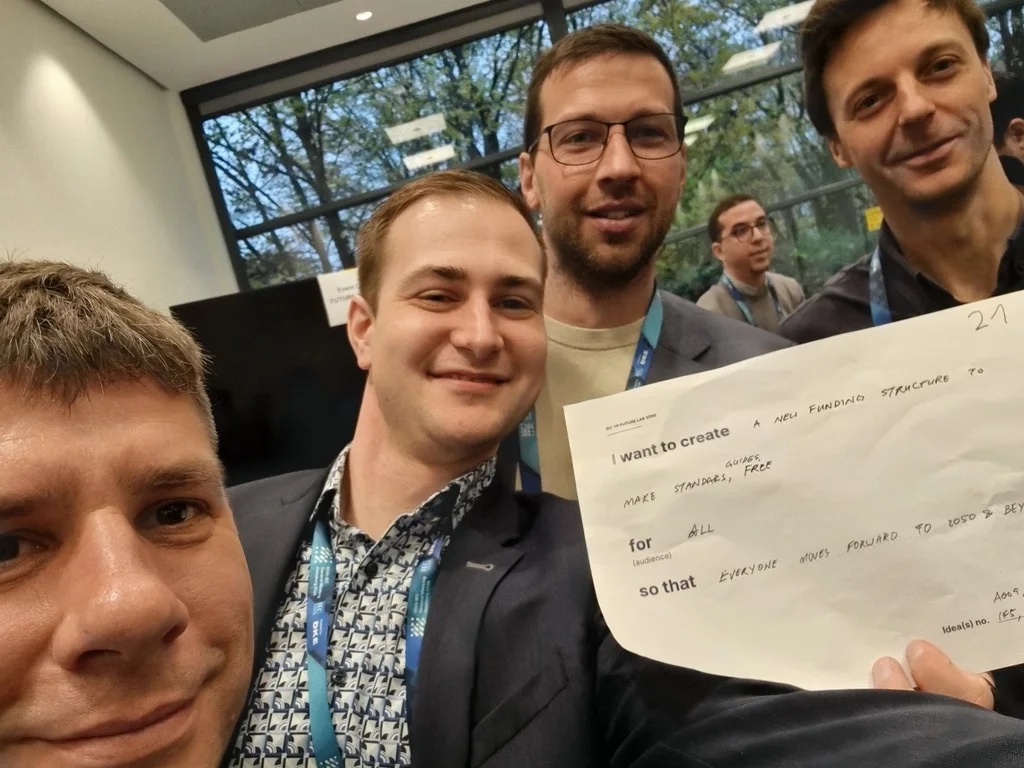
The group also explored funding IEC through UN affiliation and making an IEC contribution visible on a product receipt.
Archive ID 05.1
UN affiliation as a funding model
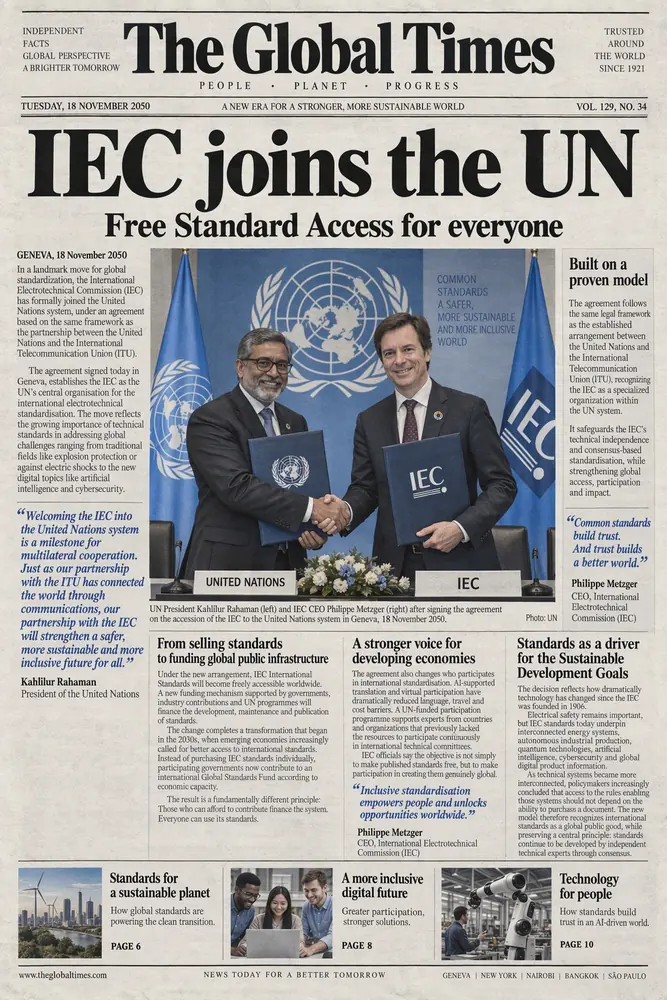
Explore what government-backed funding could mean for access to IEC standards. The team asked how IEC could finance its work in 2050. It explored whether a different institutional home could change who funds standards development and how people access the result.
How the concept could work
- Explore an affiliation with the United Nations, using organizations such as the ITU as reference points raised in the pitch.
- Replace or supplement some revenue with funding routed through governments under the proposed arrangement.
- Use the changed funding base to pursue wider access, as imagined in the workshop newspaper.
Feedback and discussion
The mock newspaper imagines the IEC joining the UN and standards becoming free to access. The team reported mixed expert reactions and questioned whether affiliation would actually solve the funding problem. Free access was a proposition illustrated by the prototype.
Discussion question
What commitments would governments need to make, and what governance and funding terms would protect the IEC’s technical independence?
Archive ID 05.2
Visible IEC product contribution
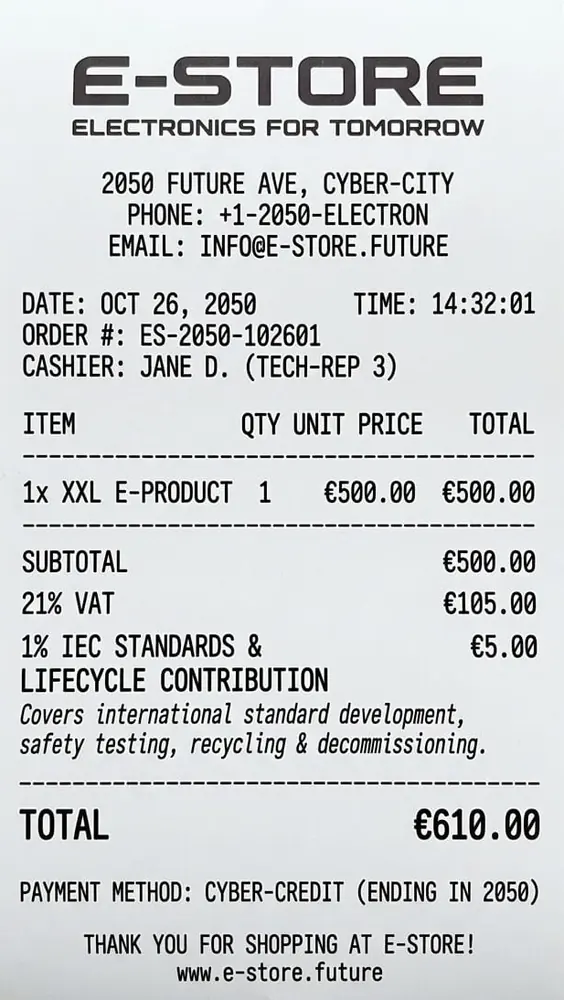
Show the customer a dedicated IEC contribution on a product receipt. Standards costs may already be reflected in what customers pay. The team explored making a contribution visible at purchase and directing it towards the work that supports products throughout their life.
How the concept could work
- Add a dedicated contribution as a line item on the retail receipt.
- Explain what it funds in terms customers can read at checkout.
- Pool the revenue to support the stated work. The mock receipt names standards development, safety testing, recycling and decommissioning.
Feedback and discussion
The future electronics receipt makes the contribution visible alongside the product and VAT. The team reported mixed expert feedback, including the observation that manufacturers may already pass these costs on through prices. The mock receipt uses an illustrative 1% contribution. The rate was open.
Discussion question
Who would collect and allocate the contribution, and how would the scheme show what extra value it provides to buyers?
Archive ID 05.3
Licensing individual standards clauses
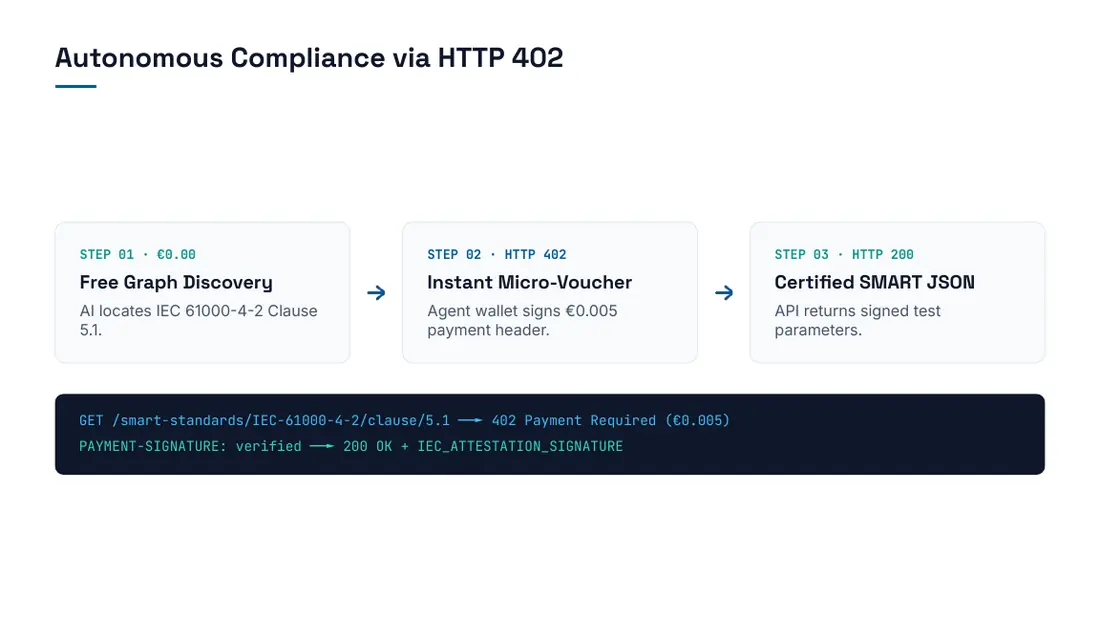
Let an automated tool pay for the verified requirement it needs at the moment it needs it. A whole-document licence makes sense for human reading, yet a compliance tool may need a specific machine-readable test parameter. The team saw a potential revenue source in licensing at that smaller unit.
How the concept could work
- Give the tool open discovery of relevant requirements in a standards index.
- Charge for access to an individual clause or structured requirement. The prototype depicts an HTTP 402 payment request and a micro-voucher.
- Return a signed machine-readable payload and allocate royalties under the licensing rules.
Feedback and discussion
The presentation proposed separate markets for atomic clauses. The slide prototype makes that concrete with a two-layer index and metered payloads, using an illustrative €0.005 charge. It distinguishes a transient lookup from enterprise caching or use for model training.
Discussion question
How can a user buy one clause and still get the definitions, dependencies and edition context required to apply it correctly?
Thursday · 19 November
Testing and revisions
What the team heard
Experts gave mixed responses to the two alternative funding models. Some questioned whether UN affiliation would solve the funding problem. Others pointed out that the product price may already include standards costs.
What changed
The group developed the clause-licensing route into a pay-per-use proposal for software. It identified cross-references and terminology that a tool would also need to handle.
Questions still open
What context and cross-references must travel with an excerpt, and who pays for them?
Friday · 20 November