Table 3 · Developed project · Thursday
IEC Living Standards
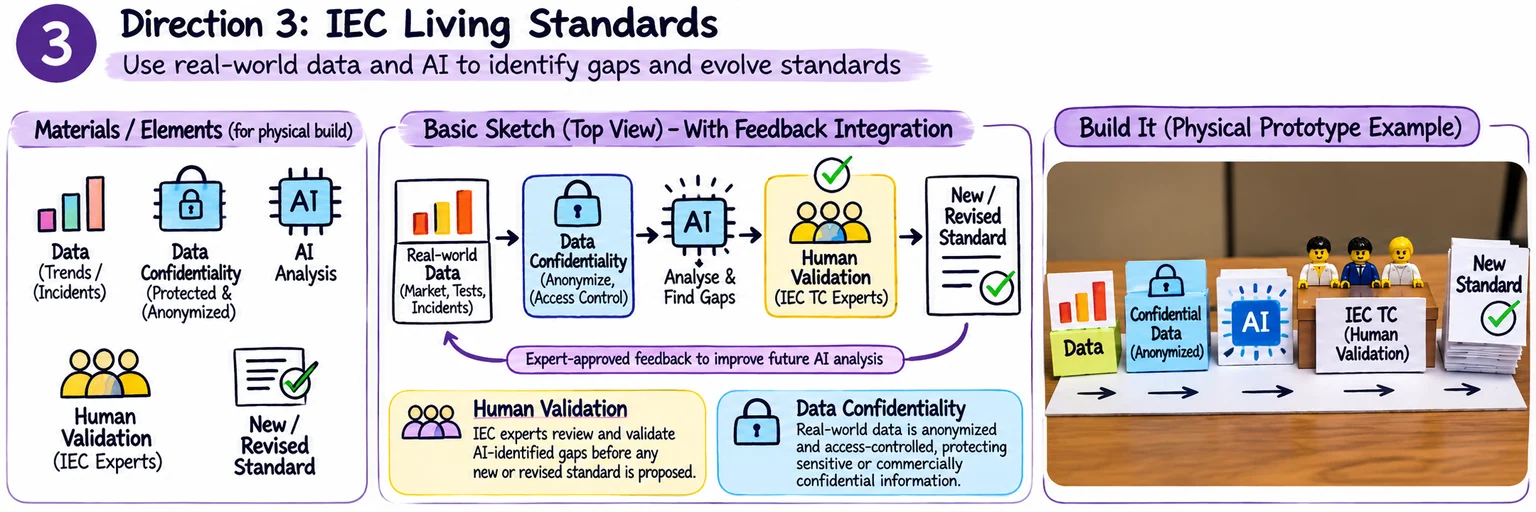
What should happen when equipment behaves differently in practice from what its standard assumes? The team proposed bringing authorised evidence from industry, research institutions and test laboratories to technical experts. An AI tool could flag a pattern. Experts would inspect it and decide whether it warrants a review.
What the team learned
Visitors evaluating Living Standards asked who would validate AI findings and how confidential data would be protected.
Wednesday · 18 November
Three early concepts
IEC Standards GPT helped people find and understand standards. Smart Conformity helped review assessment evidence. Living Standards asked what experience in the field could tell a standards committee.
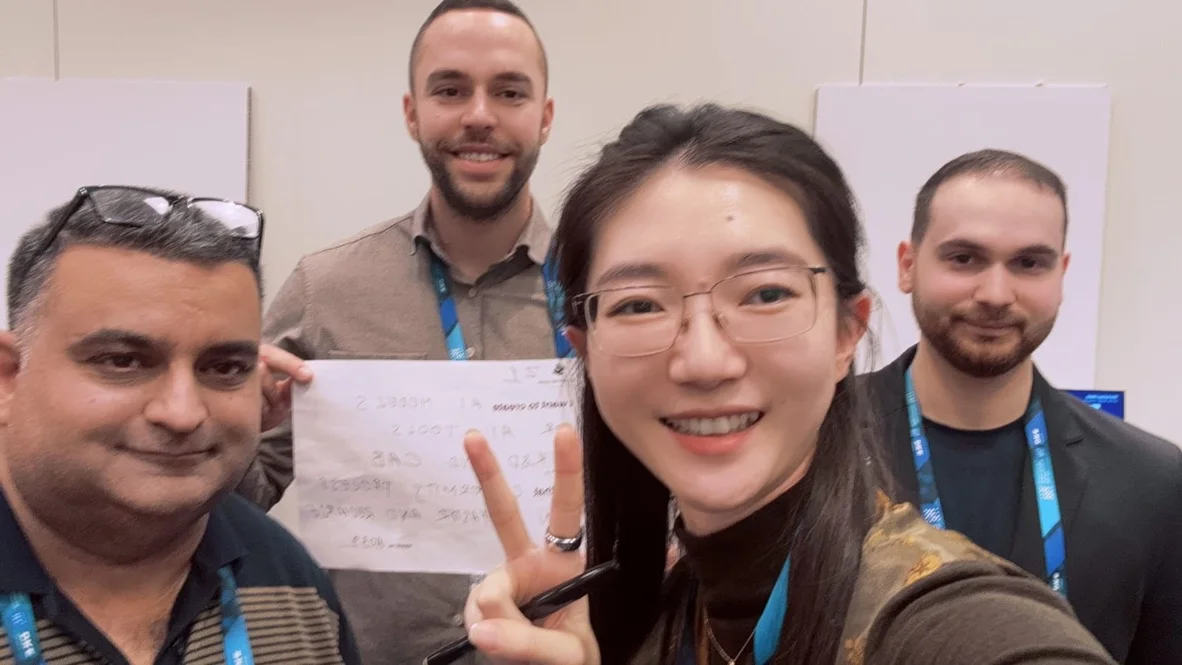
Archive ID 03.1
IEC Standards GPT
Answer a standards question and point the user towards the IEC material they need. Someone with a technical question may be unfamiliar with the IEC catalogue or which standard applies. The team presented an IEC-focused language model as one way to make those resources easier to navigate.
How the concept could work
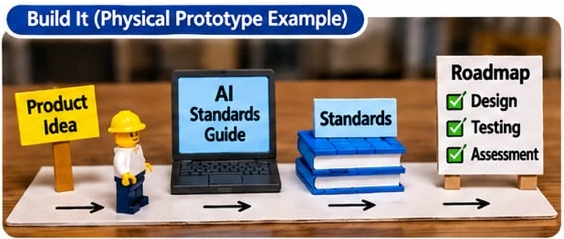
- Enter a question or product context in an IEC-focused assistant.
- Find the standards relevant to the question. The physical sketch also depicts a standards guide between the AI and user.
- Show the applicable material and a roadmap for next steps, as pictured in the sketch.
Feedback and discussion
The shared prototype board shows a physical model and names AI guidance, standards and a roadmap as distinct parts. At the final presentation the team reported that two outside reviewers saw overlap with existing work. The team chose to continue with Living Standards.
Discussion question
Which task would an IEC-specific assistant handle better than existing tools, and what would it need to show so users can check an answer?
Archive ID 03.2
IEC Smart Conformity Assessment
Use earlier conformity evidence to help assess a new request. Conformity assessment bodies can face repeat cases that resemble work they have already reviewed. The team explored using AI to find reusable evidence and speed up decisions.
How the concept could work
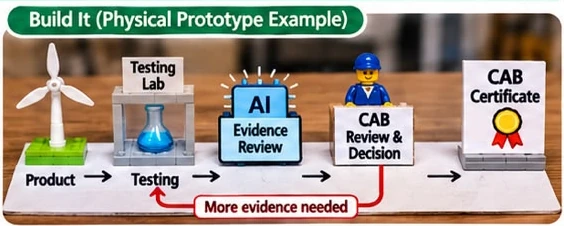
- Start with a test request and the available product and assessment evidence.
- Have AI look for similar cases and prepare an evidence review for the conformity assessment body.
- Where similarity is sufficient, use a faster certification route. The presentation envisaged direct certification in such cases.
Feedback and discussion
The pitch left the threshold for direct certification open. On the prototype board, the assessment body issues the certificate only after approval and can request more evidence. The team reported overlap with existing work and chose Living Standards for further development.
Discussion question
What would count as an equivalent case, and who would be accountable for approving reuse when the product, scope or standard edition differs?
Archive ID 03.3
IEC Living Standards
Turn data from industry and labs into questions that committees can act on. Committees need a way to learn where existing standards leave gaps as products, tests and operational conditions change. The team proposed an ongoing route from industry and lab observations to committee work.
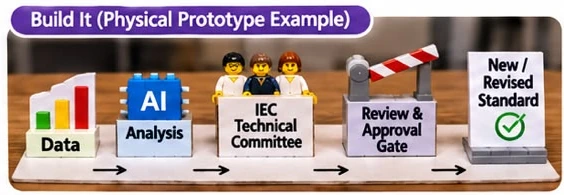
How the concept could work
- Collect and analyse data from industry and laboratories.
- Send the findings to an IEC committee for experts to review, annotate and identify missing information.
- Use the findings to propose new standards work or another project for committee consideration.
Feedback and discussion
The workshop board depicts a pipeline from industry and lab data through analysis and expert discussion. The team reported that two outside reviewers supported this direction and saw overlap with existing work in its other two proposals. This was the direction the team chose to pursue.
Discussion question
What evidence would be sufficient to open a work item, and how could a committee distinguish a widespread gap from a pattern in one contributor’s data?
Thursday · 19 November
Testing and revisions
What the team heard
Two outside reviewers recognised existing work similar to the first two ideas. Visitors evaluating Living Standards asked who would validate AI findings and how confidential data would be protected.
What changed
The team chose Living Standards and added controlled access, authorised use and anonymisation where appropriate. IEC technical experts would check the evidence, ask for missing information and decide what to take through the consensus and approval process.
Questions still open
What happens when the evidence is incomplete or points to conflicting conclusions?
Friday · 20 November